Filtering DNS that can keep your logs at home.

opdns is a filtering DNS resolver, like NextDNS or ControlD, with one difference: a node you can run at home. It is the same resolver on your own hardware, and the place your query logs can live instead of our cloud.

Join the waitlist Read the docs

opdns@edge:~$ private alpha live now, public beta later in 2026

See every location on the live status page.Live status: opdns.fail · map data

Filtering. Your logs. Your node.

Filtering

opdns blocks ads, trackers and malware before anything loads. A blocked name gets a block answer instead of an address.

Blocks:

  • ads and trackers, from public blocklists you pick
  • malware and newly registered domains
  • parental controls: categories and services from free lists, with schedules
  • your own deny, allow and rewrite rules

Set up with:

  • DNS-over-HTTPS, DNS-over-TLS or DNS-over-QUIC, with a device name in the address
  • a per-profile IPv6 address for plain DNS
  • a linked IPv4 address, kept current by a DDNS updater
  • a generated configuration profile for Apple devices
DoH
https://dns.opdns.net/profile-id/device
DoT, DoQ
device-profile-id.dns.opdns.net

Your endpoints Setup guides

Logs you control

Each profile says where its query logs go, and whether there are any.

Where logs go:

Cloud
opdns stores them until your retention period ends, 1 to 90 days.
Your node
Sent to your node and not stored in the cloud. opdns holds them until the node acknowledges them, for 24 hours at most.
Both
A copy in each place.
None
Our control plane discards them when they arrive.
Logs off
No record leaves the PoP (a server location). The profile gets hourly counters only.

Also per profile:

  • client IP logging off, applied on the PoP
  • domain logging off, applied on the PoP
  • retention from 1 to 90 days

Queries with no profile:

  • answered unfiltered, like a public resolver
  • no per-query record, only counters without addresses or names
  • rate limits held in memory only

The PoP that answers a query still sees it. A record bound for your node also passes through our log stream on the way.

Where each setting applies The public path

A node at home

opdns-node runs the same resolver code as our PoPs: the same listeners and policy engine, with its own Unbound. It comes as one container or a static binary. A Raspberry Pi, a home server or a NAS is enough.

What it does:

  • when the internet or opdns is down, keeps filtering with the last profile and lists it received
  • logs the queries from your devices in its own SQLite file, and they never reach us
  • shows up in the same dashboard, which reads its logs over the node's outbound link

What we see from it:

  • its id, versions, uptime, last sync, log file size and public IP address
  • dashboard results in transit, relayed through our servers with TLS on each hop, and not stored

The beta ships both modes. Enrolled: you manage the node from the dashboard. Standalone: no account, a profile file and a small local API.

Self-hosted node Logs on your node

One dashboard for the cloud and the node.

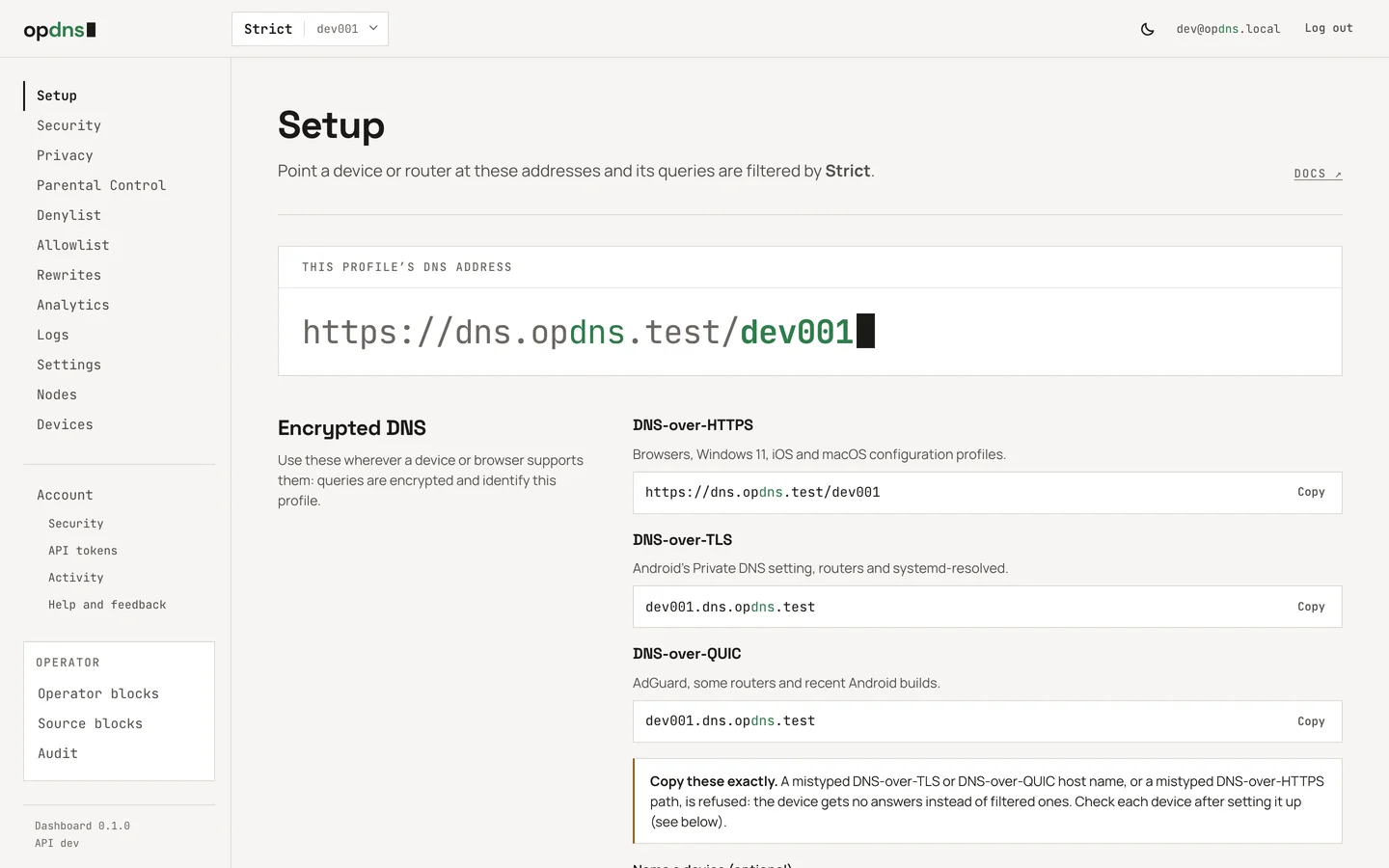
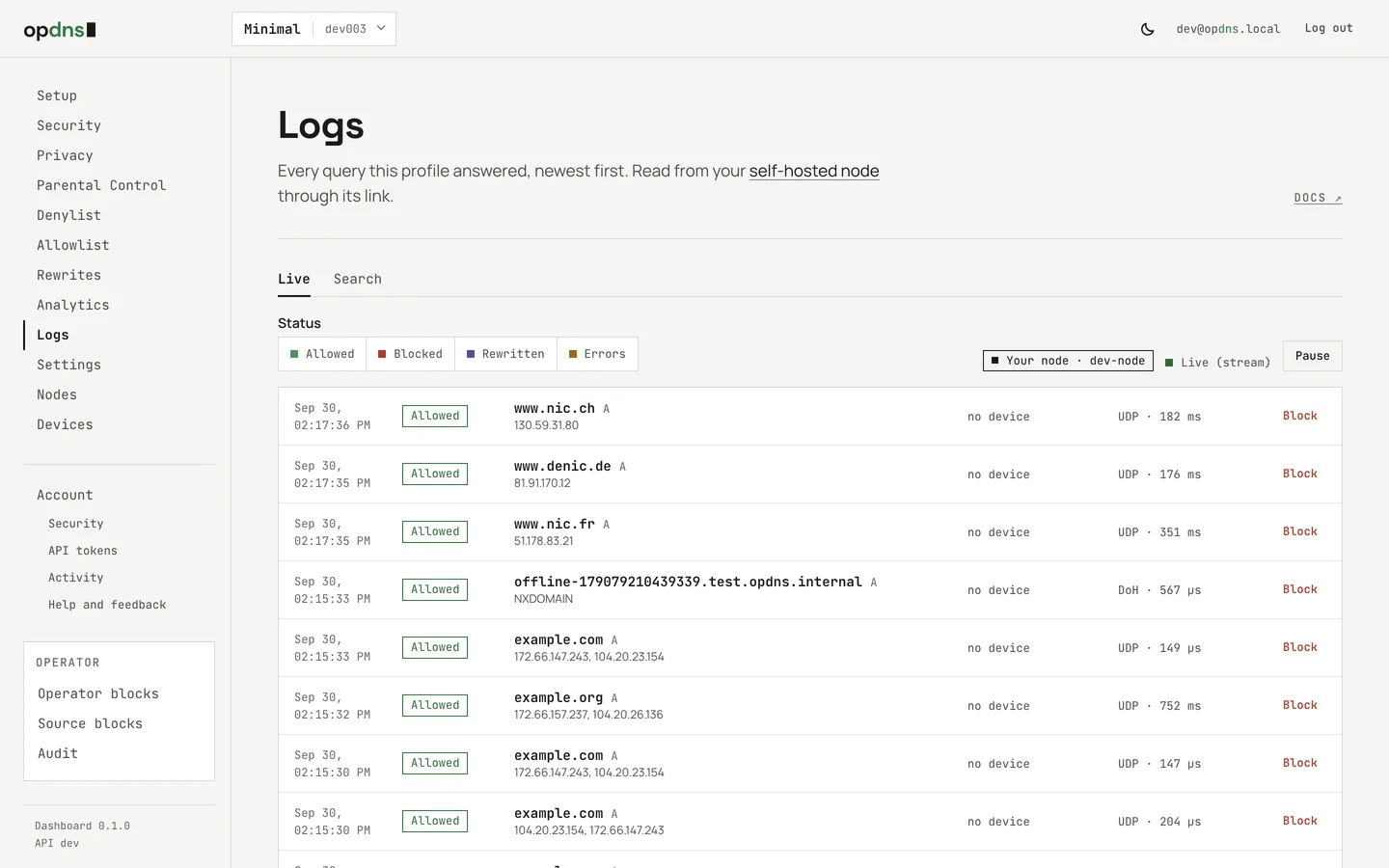
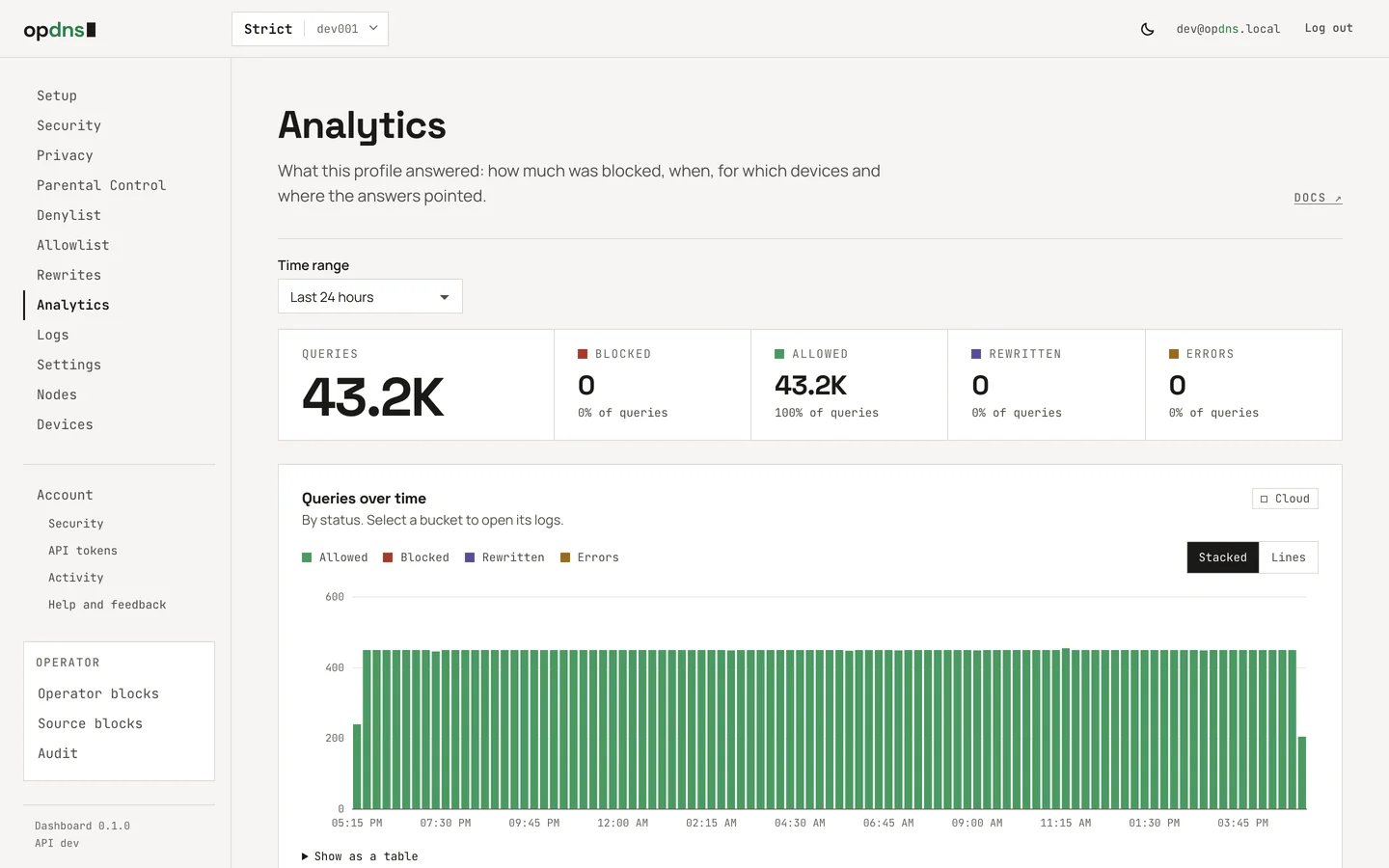
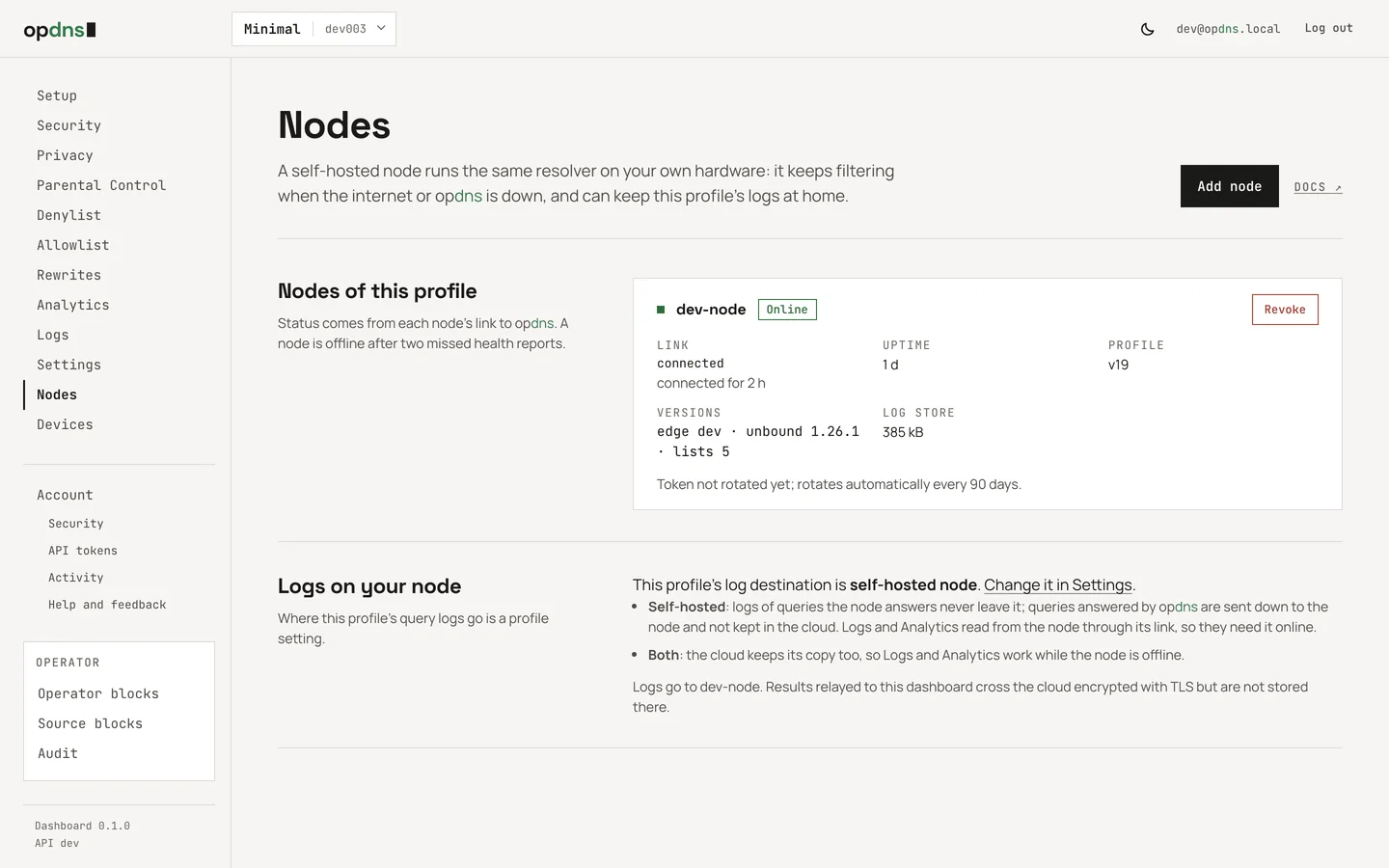
We took these screenshots with test data. The addresses end in .test, and nothing here belongs to a real user.

The Setup page: the profile's DNS address, then its DNS-over-HTTPS, DNS-over-TLS and DNS-over-QUIC addresses, each with a Copy button.
Setup
The Logs page in Live mode for a profile whose logs go to a self-hosted node: each query's time, status, name and answer, device, transport and latency, with a Block action.
Logs
The Analytics page for the last 24 hours: totals of queries, blocked, allowed, rewritten and errors, and queries over time by status.
Analytics
The Nodes page: one enrolled node, online, with its link, uptime, profile version, software versions and log store size, and where the profile's logs go.
Nodes

Three paths a query can take.

Your devices reach the nearest opdns PoP by anycast. What happens to the log record depends on the profile. A device at home can skip the cloud entirely.

Three paths: cloud logs, logs sent to your node, and queries answered at homeYour devices reach the nearest opdns PoP (a server location) by anycast. The PoP filters the query and resolves allowed names with its own Unbound. Logs off and client IP off apply on the PoP. For the Cloud or Both destination, the log record then goes to the cloud log store. For your node, it goes to a queue that keeps it until the node acknowledges it, for 24 hours at most. The queue is delivered over the outbound link of the node. The dashboard reads cloud logs from the store. It reads node logs from the node through the link, relayed and not stored. Your node answers and logs the devices at home that query it directly, and those queries never touch the cloud.opdns control planeYour networkYour devicesphone, laptop, routerAnycast PoPopdns-edge + Unboundfilters, then resolveslogs off: no record leavesclient IP off: removed hereCloud log storedestination cloud or bothQueue for your nodeuntil received, 24 h at mostDashboardapp.opdns.ioDevices at homepointed at the nodeopdns-noderesolver + SQLite logslink, opened by the nodereads relayed,not storednever touches the cloud
query to opdnslog recorddashboard readquery at home
Cloud logs
The PoP filters and answers. With the Cloud or Both destination, opdns stores the record in the cloud.
Logs to your node
The same answer. opdns queues the record and delivers it over the link that your node opened.
At home
Your node answers and logs the devices that point at it. Those queries never touch the cloud.

Architecture and the log model

Against NextDNS and ControlD.

What opdns adds:

FeatureopdnsNextDNSControlD
Self-hosted node, same resolverYesNoNo
Query logs on your own hardwareYesNoNo
Resolver and control-plane source publishedYesNoNo
DNS-over-QUICYesNoYes

Where opdns is behind:

  • no apps in the app stores yet: setup uses the operating system's own settings, or the opdns CLI forwarder
  • thinner parental controls, from free lists
  • cloud logs are stored in Canada only, and for now the alternative is to keep logs on your node
  • no per-device names on plain IPv4 DNS, by design (encrypted DNS carries them)

The full feature tableWe check competitor entries against their public documentation before launch.

Source available. Free for personal use.

At the beta, we publish the whole repository under the Source First License 1.1: resolver, control plane, dashboard and node. Read it, build it, change it, and run the node at home for free.

Needs a commercial license:

  • a business, school or other organization that self-hosts the node
  • an IT contractor who deploys it for clients
  • offering opdns or a fork as a service

The license is source-available, not open source. It does not convert to an open-source license later.

What the license allows

Private alpha, live now.

opdns is in private alpha and already live. The resolver and the dashboard are running, and access is by invitation. The public beta follows later in 2026. Join the waitlist, and we will email you when your invitation is ready.

In the public beta:

  • the resolver on every transport, over an anycast network
  • the dashboard and the API
  • logs and analytics with the per-profile settings above
  • linked IPs with a DDNS updater
  • the self-hosted node, enrolled or standalone

We use this address only for access emails and never share it. To have it removed, write to privacy@opdns.io. The form sends it to api.opdns.io. This page loads nothing from other sites and sets no cookies.